The global future-of-work conversation often begins with a familiar set of questions: Will artificial intelligence replace workers? Which occupations will disappear? How quickly must people reskill? How many green jobs will decarbonisation create?
These are important questions. But they are not context-free. They emerge from particular demographic structures, labour markets, technological infrastructures and knowledge traditions. A question designed for an ageing, highly formalised and deeply digitised economy may illuminate part of Pakistan's future, but it cannot define it.
Across the OECD, the working-age population aged 20–64 is projected to shrink by around 8% between 2023 and 2060, and by more than 30% in over one-quarter of OECD countries. Population ageing is consequently becoming a central constraint on labour supply and economic growth. OECD, 2025 ↗
Pakistan faces a different demographic challenge. Government projections for 2025 put the population at about 252.09 million; approximately 66.03% are below age 30, while people aged 15–29 account for around 66.96 million. These are projections rather than a new census count, but they demonstrate the structural difference clearly. Pakistan Economic Survey 2025–26 ↗
Different starting conditions require different foresight questions.
For many ageing economies, the question increasingly becomes: How can technology maintain productivity when the available workforce contracts?
Pakistan's question is closer to: How can a young, unequal, climate-exposed and substantially informal economy create productive and dignified opportunities while AI, digital platforms and ecological transition simultaneously transform work?
There is no single Future of Work
Technologies travel globally. Futures do not.
Artificial intelligence may be built from globally distributed research and deployed through transnational platforms, but it enters societies with very different educational systems, gender relations, labour protections, infrastructures, languages and ecological pressures.
The International Labour Organization estimates that approximately one-quarter of global employment has some exposure to generative AI. Exposure varies strongly by development level: around 34% of employment in high-income economies, compared with approximately 11% in low-income economies. The ILO also cautions that exposure does not equal job disappearance; transformation and augmentation are more plausible outcomes for many occupations. ILO, 2025 ↗
For Pakistan, AI therefore arrives not into a single modern labour market but into several labour realities simultaneously.
Pakistan's labour-market baseline changes the question
Pakistan's latest Labour Force Survey reports an unemployment rate of 7.1%. The Pakistan Economic Survey reports a civilian labour force of about 83.14 million and approximately 77.24 million employed people. PBS Labour Force Survey 2024–25 ↗
Gender reveals a deeper structural issue. Under the latest PBS framework, labour-force participation is 68.7% for males and 22.7% for females. Among the 15+ population, the corresponding rates are 80.4% and 26.3%. The measurement changes; the structural inequality does not. PBS, 2024–25 ↗
Informality creates another challenge. Among 33.6 million employees classified by formal/informal status in the latest LFS, 27.4 million, or 81.7%, are informal employees. This is not the same as saying 81.7% of every job in Pakistan is informal; the denominator is employees within that classification. PBS, 2024–25 ↗
These realities mean that “the Pakistani worker” is not a meaningful single category. The transition may look radically different for a Karachi software developer, a platform freelancer, a home-based woman worker, a farmer confronting heat and water stress, a solar technician, a delivery rider, a factory worker or a young graduate trying to secure a first professional position.
Future-of-work policy therefore needs to investigate work ecosystems, not merely predict occupational titles.
Transition One: Digital
Pakistan's digital transition is economically significant. The State Bank, citing the 2024–25 Labour Force Survey, reports approximately 2.3 million digitally employed or gig workers, around 2.9% of overall employment. State Bank of Pakistan, FY2026 ↗
During July–March FY2026, official ICT export remittances reached approximately US$3.38 billion, up 19.7% from the corresponding period a year earlier. Recorded tech-freelancer export earnings were approximately US$856.3 million, up 51%. Pakistan Economic Survey 2025–26 ↗
But this digital economy coexists with foundational capability gaps. PBS's HIES 2024–25 reports approximately 63% literacy among people aged ten and above, 57% internet use, about 50% mobile/smartphone ownership, and 28% of children aged 5–16 out of school. Pakistan Bureau of Statistics ↗
This suggests that Pakistani AI readiness cannot be reduced to teaching prompt engineering. A more useful capability sequence is:
Foundational literacy → Digital access → Domain knowledge → Critical thinking → AI literacy → Ethical judgement → Futures Literacy → Economic agency.
Without the earlier layers, advanced AI capability risks becoming concentrated among people already positioned to benefit.
Transition Two: Green
The ecological transition is already changing work. IRENA and the ILO estimate that renewable-energy employment reached at least 16.6 million jobs globally in 2024. IRENA/ILO, 2026 ↗
Pakistan presents an especially interesting case. IRENA estimates that rapid solar-PV expansion supported approximately 180,000 jobs in 2024, especially in sales, distribution and installation, while hydropower supported an estimated 111,400 jobs. IRENA, Renewable Energy and Jobs ↗
IRENA also cites expert estimates suggesting around 15 GW of distributed rooftop, captive and off-grid solar PV by 2024. That is an expert estimate, not a complete administrative count, because behind-the-meter activity is not fully captured by official systems.
The uncertainty is itself informative. Pakistan's solar transition is partly occurring from below: households responding to electricity costs, firms investing in captive generation, installers creating services and distributors creating markets.
But installed panels are not the same as economic transformation. The strategic question is: How much of the green value chain will Pakistan capture?
Can Pakistan build capabilities in manufacturing, storage, inverters, smart grids, maintenance, recycling, energy analytics, financing, research and climate-tech entrepreneurship? A country can become greener in consumption while remaining technologically dependent in production.
Climate adaptation is also employment policy
Pakistan's ecological challenge is not limited to decarbonisation. It must adapt.
The 2022 floods killed more than 1,700 people, displaced more than 8 million and generated more than US$30 billion in damages and economic losses. World Bank ↗
The World Bank's Pakistan Country Climate and Development Report models that the combined effects of climate-related events, environmental degradation and air pollution could reduce Pakistan's GDP by at least 18–20% by 2050 relative to a counterfactual trajectory without those risks. This is a modelled projection, not an observed future fact. Pakistan CCDR ↗
The implication is that climate policy is also agricultural policy, industrial policy, health policy, urban policy, skills policy and employment policy.
Transition Three: Epistemic
Digital transformation changes what people do. Green transformation changes how economies interact with ecological systems. A third transition concerns whose knowledge is recognised when those transformations are designed.
Who defines the problem? Whose evidence enters an AI model? Which languages are computationally visible? Who is invited into foresight? Who defines what “progress” means? Whose understanding of land, water, work and community becomes part of the decision?
These are questions of epistemic justice.
Research on sustainability transitions in the Global South has challenged the dominance of Western institutional assumptions and called for greater attention to informal institutions, inequality, power, everyday struggle and participatory knowledge production. Ghosh et al., 2021 ↗
The IPCC likewise recognises the contribution of Indigenous and local knowledge to climate adaptation and resilience. The argument is not that traditional knowledge should replace science. It is that useful knowledge does not flow in only one direction. IPCC AR6 WGII ↗
Pakistan already contains knowledge infrastructures worth learning from
The Kalasha practice of Suri Jagek, meaning “observing the sun,” is a traditional meteorological and astronomical knowledge system based on observing the sun, moon, stars and shadows in relation to local topography. UNESCO inscribed it in 2018 on the List of Intangible Cultural Heritage in Need of Urgent Safeguarding. UNESCO ↗
Balochistan's karez systems offer another example: longstanding community-based systems for water management in arid landscapes, where infrastructure, maintenance, allocation and social governance are interconnected. UNESCO World Heritage Centre ↗
These examples should not be romanticised. Traditional knowledge can be incomplete. Scientific knowledge can be incomplete. Algorithms can be incomplete. The opportunity lies in knowledge pluralism and responsible co-production.
AI makes the epistemic transition urgent
AI increasingly mediates access to knowledge. Yet machine-readable knowledge is not synonymous with human knowledge.
UNESCO notes that more than 7,000 languages are spoken globally while only around 1,000 have a meaningful online presence. UNESCO ↗
For Pakistan, this raises questions extending far beyond Urdu-English translation. What happens to knowledge expressed through Sindhi, Pashto, Punjabi, Balochi, Saraiki, Brahui, Shina, Balti, Kalasha and other languages? What happens to orally transmitted knowledge? Who has authority to digitise community-held knowledge? Who owns it afterward?
AI capability is therefore partly a problem of computing. It is also a problem of representation, language and knowledge governance.
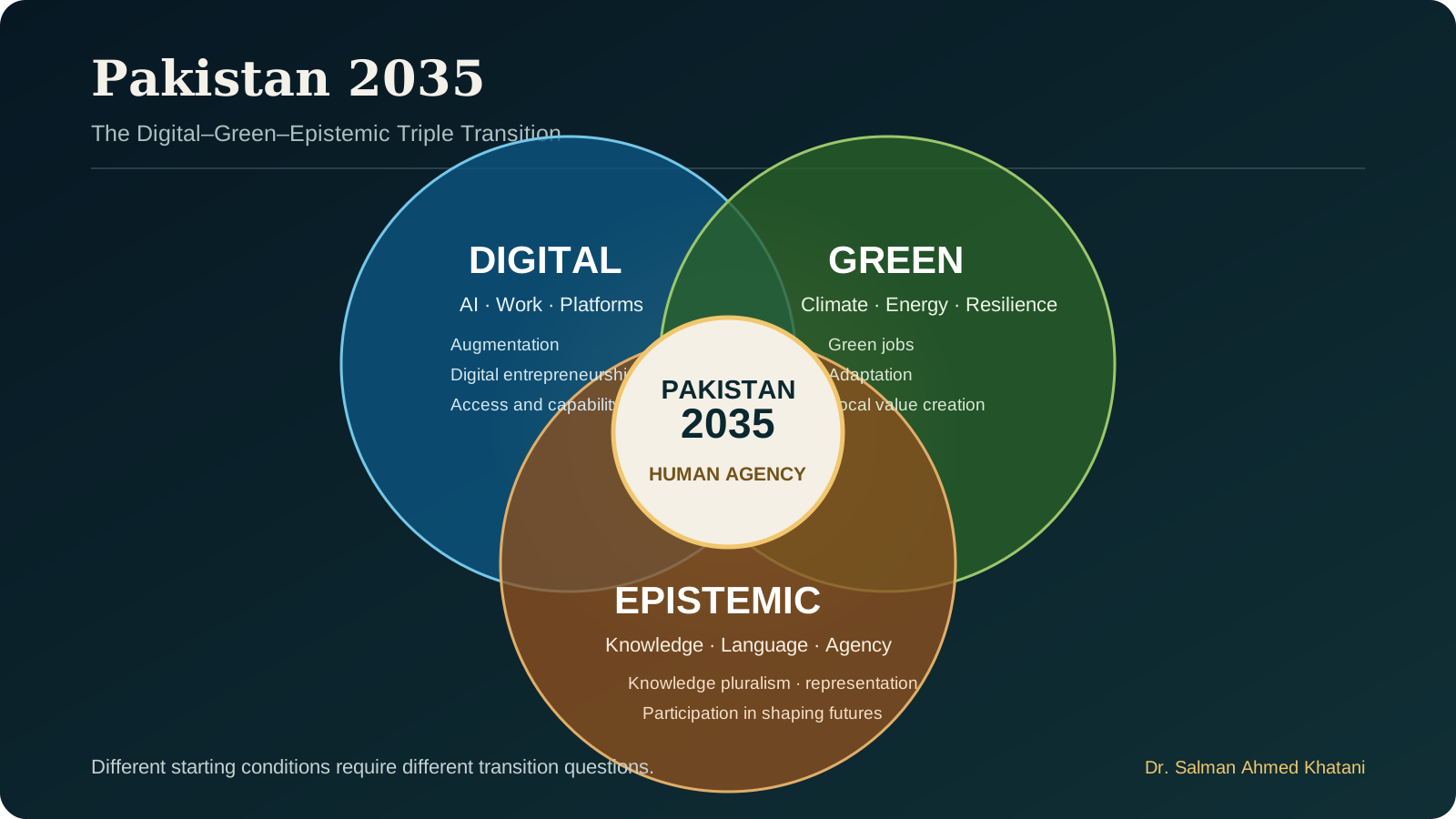
The Digital–Green–Epistemic Triple Transition
The phrase Triple Transition itself is not new. OECD work, for example, has used it for a formulation involving digital, green and social transitions. OECD ↗
The proposition here is a specific Pakistan/Global South formulation:
Digital
AI, automation, digital platforms, data, augmentation and digital entrepreneurship.
Green
Decarbonisation, adaptation, resilience, renewable energy, circularity and regenerative livelihoods.
Epistemic
Knowledge plurality, language, representation, knowledge ownership, local and Indigenous knowledge where applicable, and participation in defining preferable futures.
Social justice is not discarded. It runs across all three through gender, youth, education, informality, labour rights, regional inequality, access and distribution of benefits.
Who gains capability? Who gains income? Who gains voice? Who gains ownership? And who gains the power to shape what happens next?
From reskilling to agency
Much of the Future of Work literature presents workers primarily as adapters: technology changes, workers reskill, markets change, workers reskill again.
Adaptability matters. But the model is incomplete. Workers and communities are not only objects of transition. They can also participate in determining its direction.
For Pakistan, the future capability stack should connect AI literacy with Futures Literacy; technical capability with ethical judgement; entrepreneurship with ecological understanding; scientific knowledge with contextual knowledge; global participation with local understanding; and adaptability with the ability to question undesirable futures.
The ultimate future skill may therefore be the ability to ask: What future does this technology make more likely? Who benefits? Who bears the cost? Which alternatives disappear? And what future would we prefer to create instead?
What Pakistan should do now
- Build a Pakistan AI-and-work observatory. Pakistan needs its own task-level evidence rather than borrowing occupational-exposure percentages from different labour markets.
- Connect green deployment to industrial capability. Solar installation should be accompanied by strategies for local technical capability, maintenance, component manufacturing, storage, recycling, research and entrepreneurship.
- Make women a central test of transition success. A transition that digitises and decarbonises without substantially expanding women's economic agency should not be described as inclusive transformation.
- Rebuild education around capability, not isolated skills. Foundational literacy and digital access must sit alongside critical thinking, AI literacy, ecological literacy and Futures Literacy.
- Develop national infrastructure for Pakistani languages and knowledge. Digitisation should expand representation while respecting consent, attribution, ownership and community governance.
- Institutionalise foresight. Government, universities, businesses and civil society should explore multiple plausible futures rather than depend solely on linear forecasts.
Seven Pakistan 2035 Delphi propositions
These propositions are intended as the basis of a formal foresight study, not as predictions. Experts should separately assess probability, desirability, impact, timing and confidence, then explain drivers, barriers and distributional consequences. Real-Time Delphi can allow participants to reconsider their judgements after seeing anonymised group feedback.
The objective should not be to force consensus. Persistent disagreement is itself foresight evidence.
The Global North is a comparator, not a destination
This argument is not anti-Western, nor should Pakistan reject successful institutions, technologies or research developed elsewhere. The distinction is between learning and imitation.
Copenhagen, Warsaw, Seoul, London and Silicon Valley provide evidence, experiments, partners and warnings. But they do not constitute a predetermined destination.
Pakistan's technological future will emerge through its own demographic profile, ecological vulnerabilities, labour institutions, entrepreneurial behaviour, cultural histories and knowledge systems.
The central question is therefore not: When will Pakistan catch up with somebody else's future?
What would a technologically capable, ecologically resilient, economically inclusive and epistemically plural Pakistan look like by 2035, and what capabilities must we build now to make such futures possible?
That is why Pakistan needs more than technological adaptation. It requires a Digital–Green–Epistemic Triple Transition.
Its success should ultimately be measured not only by AI adoption, renewable capacity or export revenues, but by something more fundamental: how much human and collective agency the transition creates.
The future should not merely happen to us. We should develop the capacity to participate in creating it.
Data integrity note
Observed statistics are measured through official surveys or administrative records, such as labour-force participation and recorded ICT exports.
Institutional estimates involve incomplete measurement or estimation, such as IRENA's estimates of renewable-energy employment and distributed solar capacity.
Modelled projections are conditional forward-looking calculations, such as OECD demographic scenarios and World Bank climate-GDP effects.
These categories should not be interpreted as having identical levels of certainty.
Selected references
- Fricker, M. (2007). Epistemic Injustice: Power and the Ethics of Knowing. Oxford University Press.
- Ghosh, B., Ramos-Mejía, M., Machado, R. C., Yuana, S. L., & Schiller, K. (2021). Decolonising transitions in the Global South: Towards more epistemic diversity in transitions research. Environmental Innovation and Societal Transitions, 41, 106–109. DOI ↗
- Government of Pakistan, Finance Division. (2026). Pakistan Economic Survey 2025–26. Source ↗
- International Labour Organization. (2025). Generative AI and Jobs: A Refined Global Index of Occupational Exposure. Source ↗
- IRENA & ILO. (2026). Renewable Energy and Jobs: Annual Review 2025. Source ↗
- OECD. (2025). OECD Employment Outlook 2025. Source ↗
- Pakistan Bureau of Statistics. (2026). Labour Force Survey 2024–25. Source ↗
- State Bank of Pakistan. (2026). The State of Pakistan's Economy: Half Year Report FY2025–26. Source ↗
- UNESCO. Suri Jagek: Traditional Meteorological and Astronomical Practice. Source ↗
- UNESCO World Heritage Centre. Karez System Cultural Landscape. Source ↗
- World Bank. (2022). Pakistan Country Climate and Development Report. Source ↗